


Understanding Bowel Cancer: A useful overview
June 2026
Bowel cancer is one of the most common types of cancer and can be life-threatening if not detected and treated early. The good news, however, is that bowel cancer survival rates have improved significantly over the past few decades.
If you or someone you care about has diagnosed or suspected bowel cancer, it’s natural to have a lot of questions. Our experts explain the essential things to know, including the symptoms and signs of bowel cancer, bowel cancer testing, and the treatment options.
Bowel cancer symptoms
Recognising the symptoms of bowel cancer is vital for early detection.
Bowel cancer symptoms include:
- changed bowel habits – including diarrhoea, constipation, or altered consistency of your stool (poo)
- blood in the stool – including blood on the toilet paper or a dark, tar-like appearance in your stool
- feeling like you can’t completely empty your bowels
- abdominal discomfort – such as cramps, gas, or tummy pain
- a lump or pain in the anus or rectum
- unexplained weight loss
- unusual tiredness or signs of anaemia (weakness, pale complexion, or breathlessness).
Remember, early detection of bowel cancer gives you the best chance of a successful outcome, so see your GP if you have any of these symptoms for two weeks or more.
They can get you started on screening for bowel cancer and refer you for specialist help if needed.
What causes bowel cancer?
While experts don’t fully understand the causes of bowel cancer, several factors are known to increase your risk.
Bowel cancer risk factors
These include:
- Age – your risk increases as you get older
- A family history of bowel cancer or polyps
- Eating a lot of red or processed meats
- Smoking and drinking a lot of alcohol
- Not getting enough physical activity
- Some health conditions – including overweight and obesity and inflammatory bowel diseases (such as Crohn’s disease and ulcerative colitis).
See your GP if you have any concerns about your risk of bowel cancer.
Bowel cancer screening
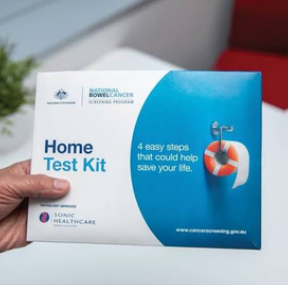
In Australia, the National Bowel Cancer Screening Program is designed to reduce bowel cancer deaths by detecting the disease in its early stages. Under the program, a free bowel cancer test kit is sent out to all eligible Australians.
The bowel cancer screening kit includes everything you need to collect a small sample of poo. The sample is sent to a lab and tested for blood, which may indicate there is a cancer in the bowel.
Previously, you could only get a bowel cancer test kit if you were aged between 50 and 74. However, from July 1, 2024, the program is being extended to eligible Australians aged 45 to 74.
National screening for bowel cancer has led to major improvements in the bowel cancer survival rate. Over 90% of bowel cancer cases can be treated successfully if they are found early enough. That’s why it’s so important to take part in national bowel cancer screening, and to see your GP if you have any bowel cancer symptoms.
Find out more about the National Bowel Cancer Screening Program.
Bowel cancer diagnosis
If your screening results or symptoms suggest possible bowel cancer, you will need to have some more tests to work out what is going on.
Bowel cancer test options include:
- Blood tests – these can check for anaemia and tumour markers
- Physical examination – your doctor may check for things like tenderness or lumps in your abdomen or rectum
- Imaging tests – a CT scan or MRI scan looks for signs of cancer within the bowel and a PET CT scan can help determine whether cancer may have spread
- Colonoscopy or sigmoidoscopy – these tests involve inserting a thin tube with a camera on the end to look for polyps or signs of cancer inside your anal canal, rectum and colon
- Biopsy – this involves testing tissue samples taken from the bowel for signs of cancer.
Bowel cancer stages
Once bowel cancer is diagnosed, the next step is to work out its stage. This helps specialists decide on the best course of treatment.
In Australia, specialists use a couple of different systems for bowel cancer staging. A common system describes bowel cancer in four stages.
Stage I: Cancer is confined to the inner layers of the colon or rectum.
Stage II: Cancer has spread to the outer layers but not to the lymph nodes.
Stage III: Cancer has spread to nearby lymph nodes but not to other parts of the body.
Stage IV: Cancer has spread to distant organs, such as the lungs or liver.
Bowel cancer prognosis
If you or someone you love has received a bowel cancer diagnosis, you will probably want to know more about what to expect.
The prognosis largely depends on the stage of the cancer. For example, the five-year survival rate for bowel cancer diagnosed at stage I is approximately 90%. This rate declines as the cancer stage at diagnosis gets higher, again highlighting the importance of early detection.
Other factors that influence prognosis include your age, overall health, the type of cancer, and how well you respond to treatment.
Each person’s circumstances are different, and your specialist can provide individual advice about the likely prognosis.

Bowel cancer treatment
There are several treatment options for bowel cancer, and the choice will depend on the cancer’s stage, location, your health, and your personal preferences.
Surgery
Early-stage bowel cancer is often managed with surgery. This typically involves removing the section of bowel where the cancer is located.
In most cases, the surgeon may be able to join the two ends of the bowel together. If the two ends cannot be reconnected or the bowel needs more time to heal, they will create an opening to the abdomen (called a stoma) to allow waste to pass out of the body.
Some stomas are temporary, and others are permanent. If you’ll need a stoma, your healthcare team will explain everything you need to know about it.
Bowel cancer surgery may be performed as open surgery or using a minimally invasive (keyhole) technique, which involves making small cuts in the abdomen to pass surgical instruments through.
Radiotherapy
Radiotherapy uses high-energy rays to target and destroy cancer cells. Radiotherapy is sometimes used before bowel cancer surgery to shrink a tumour, or afterwards to kill any remaining cancer cells. It is also sometimes used along with chemotherapy.
Chemotherapy
Chemotherapy uses drugs to destroy cancer cells. It may be used before surgery to shrink a tumour, or after surgery to kill any remaining cancer cells and to lower the risk of recurrence. It may also be recommended if surgery is not possible.
Targeted therapy
Targeted therapy uses specialised drugs to target specific molecules that cause cancer to grow and spread.
These drugs are usually used in more advanced stages of bowel cancer.
Palliative care
In some cases, palliative care may be recommended. Palliative care is about keeping you comfortable and maintaining your quality of life rather than trying to cure the cancer. It may involve therapies to slow the cancer’s spread, ease pain or other symptoms, and help you and your loved ones live well.
Bowel cancer support
Receiving a bowel cancer diagnosis can be scary. It’s natural to experience a wide range of emotions, but you don’t have to cope with it alone. Support is available to help patients and their families deal with the challenges you might face.
Bowel Cancer Australia is dedicated to supporting people affected by bowel cancer and operates a nationwide telenursing support service. Call 1800 727 336 or email a bowel care nurse.
Cancer Australia has more information about bowel cancer support services.
Palliative Care Australia has information for people living with a life-limiting condition and their families/carers.
If you feel overwhelmed or have concerns about your mental wellbeing, talk to your healthcare team about seeing a trained mental health professional.

Reviewer:
This article has been medically reviewed by Sunnybank surgeon:
Dr Ferdinand Ong, Colorectal and General Surgeon
BMed, MD (Dist), MS, FRACS
Suite 30, Sunnybank Specialist Centre
245 McCullough Street, Sunnybank 4109
P: 07 3107 4893 | F 07 3107 4894